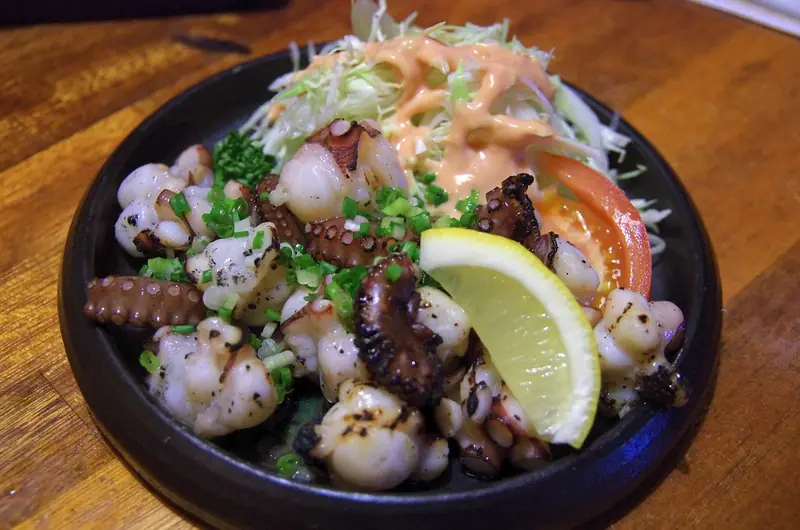
Greek Grilled Octopus
Octopus simmered with bay leaf, wine, and lemon until tender, then charred on the grill and dressed with olive oil, oregano, and lemon.
Updated: Nov 9, 2026
Why you'll like it
- Ready in about 1 hour 10 min.
- Serves 4 — easy to halve or double.
- Medium level — everyday equipment only.
- Storage, freezing and reheating covered below.
Greek Grilled Octopus takes about 1 hour 10 minutes and makes 4 servings. Octopus needs two very different kinds of heat: a gentle simmer to tenderize the thick tentacles, then a hard char on the grill or in a cast iron pan for crisp edges.
Helpful guides
Instructions
Bring a large pot of salted water to a bare simmer with the bay leaf, white wine, and the halved lemon, then add the octopus. Cover partially and cook for 45 to 55 minutes, keeping the water just below a rolling boil. A hard boil tightens the muscle and makes the tentacles tough, while a gentle simmer softens them gradually.
Test for doneness by pushing a paring knife into the thickest part of a tentacle near the base. It is ready when the blade slides in with almost no resistance, like butter. If it still feels springy, simmer another 10 minutes and test again.
Turn off the heat and let the octopus cool in its cooking liquid for about 15 minutes, then lift it out and drain it. Cooling in the liquid keeps the meat moist and lets it finish tenderizing gently instead of seizing in the air.
Cut the tentacles apart at the base and slice the head into thick strips, then pat everything very dry with paper towels. Surface water steams on the grill and blocks the char, so this step is what separates crisp edges from a rubbery, pale result.
Toss the pieces with 2 tbsp of the olive oil, 1 tsp oregano, the salt, and the black pepper. Heat a grill or cast iron pan to high heat, then cook the octopus for 3 to 4 minutes per side, pressing lightly with a spatula, until deeply charred at the tips. It is already fully cooked from the simmer, so this stage is only for color and crust.
Whisk the remaining 2 tbsp olive oil with the vinegar, the remaining 1 tsp oregano, and a squeeze of lemon, then spoon it over the hot octopus. Toss the cabbage and red onion with a little of the same dressing and serve alongside with lemon wedges.
Troubleshooting — fixes, not repeats
- If the octopus is still chewy after 55 minutes, keep simmering in 10-minute increments; large octopuses can take 75 minutes, and the knife test is more reliable than any timer.
- Do not bother adding a wine cork to the pot; there is no reason it would tenderize the meat, and only time at a gentle simmer actually does the work.
- If the skin slips off in the pot, that is normal and nothing is wrong; peel away any loose pieces before grilling so they do not burn.
- If the tentacles stick to the grill, oil the grates well and leave them undisturbed for a full 3 minutes before turning, since they release once the surface has charred.
Make it your way
- Old Dhaka style: Chop the grilled octopus into bite-size pieces and toss it with chickpeas, red onion, and parsley for a cold salad.
- Serving with rice or naan: Add 1/2 tsp smoked paprika to the oil for a warmer, smokier finish, or serve the octopus over fava puree instead of slaw.
- For an oven version, roast the simmered and dried octopus on a sheet pan at 450 degrees F for 12 to 15 minutes, turning once, until the tips char.
Storage & reheating
Cool leftovers within 2 hours, then refrigerate in a covered container and use within 3 to 4 days. Reheat only the portion you will eat until steaming hot throughout — poultry and reheated rice should reach 165°F (74°C).
Reheat in a hot skillet for 2 to 3 minutes per side to bring back some char, or serve it cold in a salad.
Seafood does not freeze well after cooking and octopus turns spongy on thawing, so freeze it raw for up to 3 months instead.
FAQ
Why does octopus turn out rubbery?
Usually because it was boiled hard instead of simmered gently, or pulled from the pot before it was actually tender. Keep the water at a bare simmer and use the knife test at the thickest part of a tentacle, continuing in 10-minute increments until the blade slides in easily.
Does adding a wine cork make octopus tender?
No. The cork trick is a myth with no mechanism behind it; tenderness comes from time at a gentle simmer and from testing with a knife. Bay leaf, wine, and lemon in the water add flavor, but nothing added to the pot shortens the cooking time.
Can I cook the octopus ahead of time?
Yes. Simmer it a day ahead, cool it within 2 hours, and refrigerate it whole in a covered container for up to 3 days. Dry it well and char it just before serving, since the grill step takes only a few minutes.