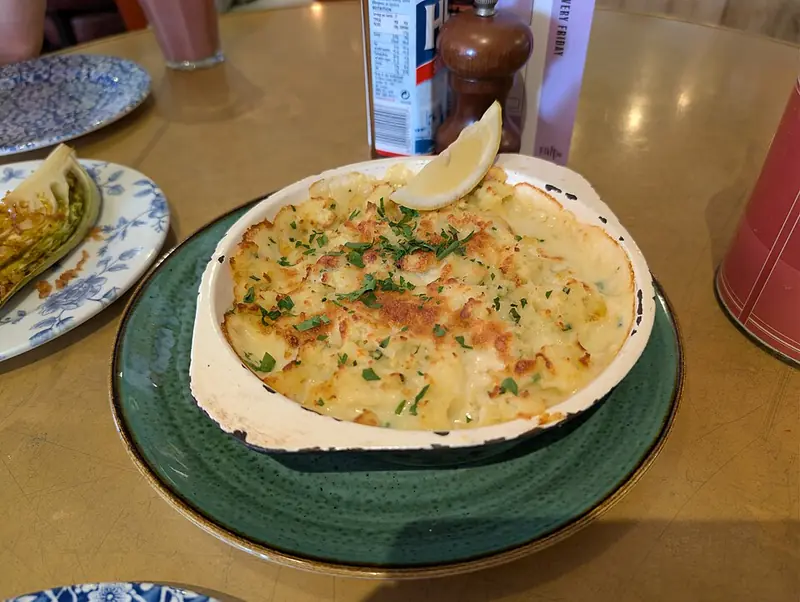
Fish Pie
Poached white and smoked fish in a mustard white sauce with peas, topped with a golden mashed potato crust.
Updated: Nov 9, 2026
Why you'll like it
- Ready in about 1 hour 10 min.
- Serves 6 — easy to halve or double.
- Medium level — everyday equipment only.
- Storage, freezing and reheating covered below.
This Fish Pie recipe takes 1 hour 10 minutes and makes 6 servings. The British version layers poached white fish and smoked fish in a mustard-scented white sauce under a mashed potato lid, with peas folded through for sweetness.
Helpful guides
Instructions
Heat the oven to 190 degrees C (375 degrees F). Boil the potatoes in salted water for 15 to 18 minutes, until a knife slides in with no resistance, then drain and mash with 1 Tbsp of the butter and 1/3 cup of the milk.
Warm the remaining milk with the bay leaves in a wide skillet over low heat, add the fish in a single layer, cover, and poach gently for 6 to 8 minutes, until it flakes and reaches 145 degrees F. Poaching in milk keeps the fish moist and builds the base of the sauce.
Lift the fish out with a slotted spoon and reserve 2 cups of the poaching milk, discarding the bay leaves. Flake the fish into large pieces and pick out any skin or stray bones.
Melt the remaining 2 Tbsp butter in a saucepan and whisk in the flour, cooking for 1 minute. Whisk in the reserved milk a little at a time, simmer 3 to 4 minutes until thick, then stir in the mustard, parsley, and a pinch of salt and pepper.
Fold the fish and frozen peas into the sauce gently so the pieces stay intact, then transfer to a 2-quart baking dish. Spoon the mash over the top, spread it to the edges with a fork, and rough up the surface so the ridges brown.
Bake for 25 minutes, until the sauce bubbles at the edges and the top turns golden, then run it under the grill or broiler for 3 to 4 minutes for deeper color. Watch closely at that stage, since a milk-based sauce scorches quickly.
Rest the pie for 10 minutes before serving so the sauce sets enough to spoon cleanly. Refrigerate leftovers within 2 hours.
Troubleshooting — fixes, not repeats
- If the sauce looks thin before baking, simmer it a minute or two longer; it thickens as the pie bakes and again as it rests.
- If the top browns before the filling bubbles, cover it loosely with foil and lower the oven to 350 degrees F.
- If the pie threatens to overflow, set the dish on a sheet pan and leave 1/2 inch of headroom when filling it.
- If you use frozen fish, thaw it overnight in the refrigerator and drain it well, since excess water thins the sauce.
Make it your way
- Old Dhaka style: Add 8 oz peeled shrimp to the filling with the peas and bake until they reach 145 degrees F, or fold in 2 chopped hard-boiled eggs, which some British versions include.
- Leeks softened in butter make a sweeter filling, and swapping the cheddar for gruyere gives a sharper top.
- For individual pies, divide the filling among 4 ramekins and bake 18 to 20 minutes.
Storage & reheating
Cool leftovers within 2 hours, then refrigerate in a covered container and use within 3 to 4 days. Reheat only the portion you will eat until steaming hot throughout — poultry and reheated rice should reach 165°F (74°C).
Reheat in a 350 degrees F oven, covered with foil, for 20 to 25 minutes until the center reaches 165 degrees F; the microwave works but softens the crust.
Fish pie does not freeze well after cooking because the potatoes turn grainy and the sauce separates on thawing.
FAQ
Can I make fish pie ahead of time?
Yes. Assemble it completely, cool it within 2 hours, and refrigerate for up to 24 hours. Add about 10 minutes to the baking time and cover the top with foil for the first 15 minutes so the potato does not overbrown.
Which fish works best in fish pie?
A firm white fish such as cod, haddock, or pollock gives structure, and smoked haddock or smoked cod adds the flavor the dish is known for. Salmon works but colors the filling pink and tastes stronger, and oily fish such as mackerel can overpower the sauce.
Why poach the fish in milk instead of water?
The milk takes on flavor from the bay leaf and from the fish itself, and that same liquid becomes the white sauce. Poaching in water would leave the sauce tasting thin unless you added more fat and seasoning.